
If you’ve looked at your server logs lately, you’ve probably noticed traffic from bots with names like GPTBot or ClaudeBot. These aren’t malicious scrapers — they’re automated crawlers run by major tech and AI companies, each with a different purpose. Here’s a quick rundown of the crawlers you’re most likely to see.
Amazonbot Amazon’s web crawler, used to improve services like Alexa and support
Amazon’s search and product indexing. It also feeds into some of Amazon’s AI initiatives.
Applebot-Extended An extension of Apple’s original Applebot crawler (which powers Siri and Spotlight search). Applebot-Extended specifically identifies content used to train Apple’s AI and machine learning models, separate from search indexing.
Bytespider (ByteDance) Operated by ByteDance, the parent company of TikTok. Bytespider crawls the web to gather training data for ByteDance’s AI models and to support content recommendation systems.
CCBot (Common Crawl) Common Crawl is a nonprofit that maintains a free, open repository of web crawl data. Many AI companies use Common Crawl’s datasets to train language models, so CCBot’s visits often represent data collection that ripples out to numerous downstream AI projects.
ChatGPT-User (OpenAI, on-demand) Unlike most crawlers on this list, ChatGPT-User isn’t doing bulk indexing. It fires in real time when a person asks ChatGPT to browse a specific page or retrieve live information from your site.
Claude-Web (Anthropic) Anthropic’s on-demand crawler, similar in spirit to ChatGPT-User. It fetches web pages in real time when a user asks Claude to look something up or reference a specific URL.
ClaudeBot (Anthropic) Anthropic’s general-purpose crawler, used to gather publicly available web content for training and improving Claude models.
Google-Extended A control that lets website owners decide whether their content can be used to train Google’s AI models (like Gemini) and power AI features such as AI Overviews — separate from standard Googlebot indexing for search results.
GPTBot (OpenAI) OpenAI’s primary crawler for collecting web content used to train and improve its GPT models.
PerplexityBot Used by Perplexity AI, an AI-powered answer engine, to crawl and index web content that helps generate real-time, cited answers to user queries.
Why This Matters
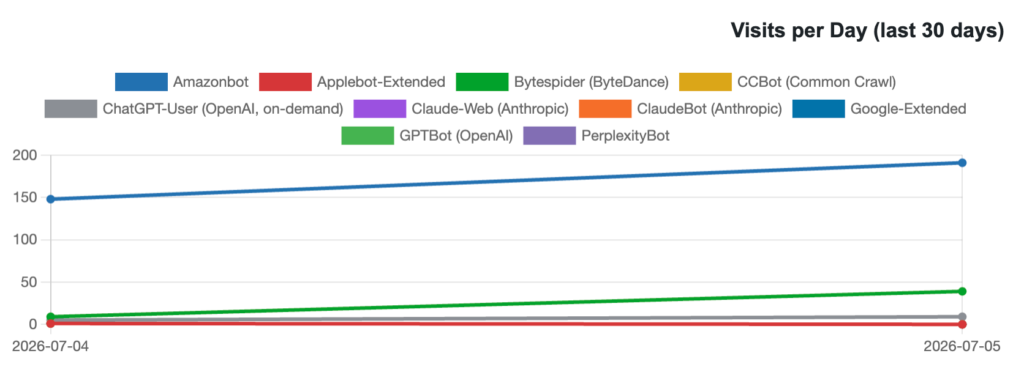
Website owners increasingly want visibility into — and control over — which bots access their content and why. Most of these crawlers respect the robots.txt standard, meaning site owners can allow or block specific bots depending on whether they’re comfortable with their content being used for AI training, real-time AI answers, or traditional search indexing. Monitoring crawler traffic, like the “Visits per Day” data shown in dashboards, helps site owners understand how much of their traffic comes from automated agents versus human visitors, and make informed decisions about which bots to permit.